

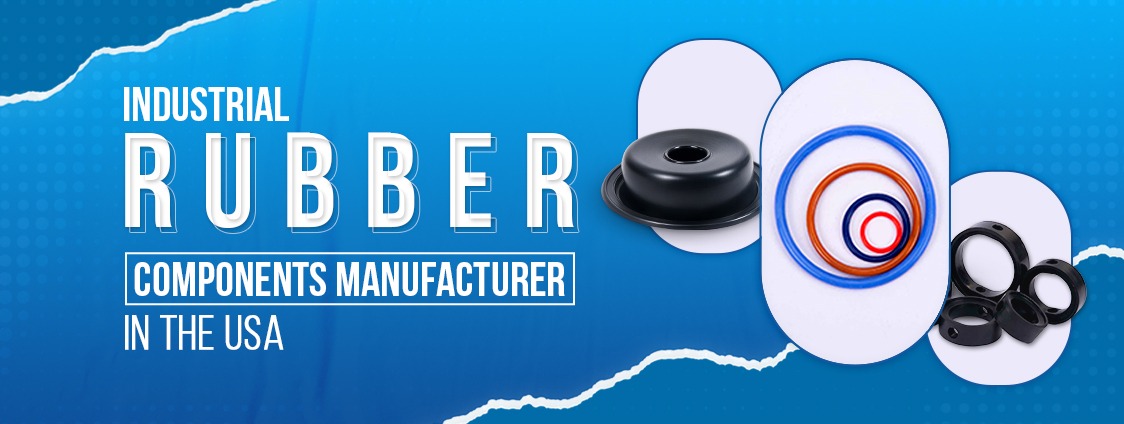
Industrial Rubber Components Manufacturer in the USA: O-Rings, Diaphragms, Seals & Gaskets

In the high-precision world of modern manufacturing, the most sophisticated machines often depend on the humblest components. While high-torque motors and digital control systems grab the headlines, it is the industrial rubber components USA firms produce that keep these systems from leaking, seizing, or failing under pressure.
From the deep-sea sensors in oil exploration to the high-purity valves in pharmaceutical labs, rubber diaphragms, O-rings, and heavy-duty seals serve as the primary line of defense against operational failure. When you are sourcing these parts, you aren’t just buying rubber; you are investing in the “mean time between failures” (MTBF) of your entire facility. Choosing the right rubber parts supplier USA partner is the single most effective way to protect your equipment and your bottom line.
1) The Critical Role of Rubber Diaphragms in Modern Industry
A rubber diaphragm is more than just a piece of flexible material. It is a precision-engineered membrane designed to perform under a constant cycle of mechanical stress. Whether it is separating two fluids in a dosing pump or regulating gas flow in a medical ventilator, the diaphragm must flex thousands (sometimes millions) of times without losing its elasticity or developing micro-tears.
Why Quality at the Source Matters
Not all rubber diaphragm manufacturers operate with the same level of technical rigor. In many industrial applications, the diaphragm is the “moving seal.” Unlike a static gasket, it is constantly in motion. This means the material selection must account for:
- Flex Life: How many cycles can the part endure before material fatigue sets in?
- Chemical Compatibility: Will the process media (oils, acids, or solvents) cause the rubber to swell or embrittle?
- Response Time: In pneumatic systems, the diaphragm’s sensitivity to pressure changes determines the system’s overall accuracy.
As leading rubber diaphragm suppliers, we emphasize that a “cheap” diaphragm is the most expensive part you can buy. The cost of replacing a $5 part is negligible compared to the cost of shutting down a production line for four hours because that part ruptured.
2) Navigating the Landscape of Industrial Rubber Components
The domestic landscape for industrial rubber components in the USA is vast, but it is increasingly segmented by quality standards. US-based manufacturers are held to some of the highest regulatory standards in the world, including ASTM (American Society for Testing and Materials) and ISO 9001.
The Advantage of Local Sourcing
When you partner with a domestic custom rubber parts manufacturer, you gain several strategic advantages:
- Supply Chain Resiliency: Global logistics are volatile. Sourcing locally eliminates the risk of parts being stuck in transit for weeks.
- Engineering Collaboration: Being in the same time zone as your rubber parts supplier USA team allows for real-time design iterations and troubleshooting.
- Traceability: For industries like aerospace or medical, knowing the exact batch of raw material used is a legal requirement.
3) Beyond the Standard: The World of Custom Rubber Manufacturing
In a perfect world, every seal would fit a standard size chart. In the real world, engineers are constantly pushing the limits of machine design, requiring geometries that off-the-shelf parts simply cannot accommodate. This is where the expertise of a custom rubber parts manufacturer becomes indispensable.
The Custom Development Process
A true partnership with a rubber parts supplier USA specialist follows a structured path:
- Design Consultation: We look at your drawings to identify “moldability” issues or potential stress points.
- Material Compounding: If standard Nitrile or EPDM won’t cut it, we develop custom blends designed for your specific temperature or chemical environment.
- Prototyping: Utilizing compression or injection molding to produce small batches for field testing before committing to high-volume production.
4) O-Rings: Small Parts, Large-Scale Impact
While we often talk about the complexity of diaphragms, the humble O-ring remains the backbone of the sealing industry. However, as machinery grows in scale, the demand for big o rings and large o rings has skyrocketed.
Sealing Large Diameters
Manufacturing large rubber O rings presents unique challenges. Maintaining a consistent cross-section over a diameter of several feet requires specialized tooling and massive presses. Any variation in the “join” of the ring can become a leak path under high pressure.
Furthermore, for high-performance environments like oil & gas, we often transition from standard materials to HNBR 0 rings. Hydrogenated Nitrile (HNBR) offers a significant step up in heat resistance and mechanical strength, making it the preferred choice for HNBR O rings USA sourcing when failure is not an option.
5) Industrial Gaskets and Heavy-Duty Seals
While O-rings handle circular interfaces, large gaskets are the heroes of flat-surface sealing. Whether it’s a flange in a chemical plant or a housing cover for a turbine, large gaskets must compensate for surface irregularities in the metal.
As an industrial gaskets manufacturer, we look for materials that offer a low “compression set.” You want the gasket to push back against the mating surfaces with the same force on day 1,000 as it did on day 1.
6) How to Vet Your Rubber Diaphragm Suppliers
If you are currently evaluating rubber diaphragm manufacturers, don’t just ask for a quote. Ask for their technical data sheets. A reliable partner should be able to provide:
- Durometer Testing: Verification of the rubber’s hardness.
- Tensile Strength Reports: How much stress can the material take before it snaps?
- Age Testing: How does the material perform after 70 hours of exposure to 150°C oil?
The transparency of your rubber parts supplier in the USA is the best indicator of their product’s long-term performance.
7) Material Science: The Heart of Every Component
The “rubber” in your machine isn’t just one material. It is a cocktail of polymers, fillers, and curing agents.
- EPDM: The go-to for weather resistance and steam.
- Nitrile (NBR): The standard for oil and fuel resistance.
- Viton (FKM): When you need to handle extreme heat and aggressive chemicals.
- Silicone: For extreme temperature flexibility and food-grade safety.
By working with a custom rubber parts manufacturer, you ensure that the specific “recipe” of your parts is optimized for your machine’s environment.
8) Engineering for Failure: Stress and Strain in Elastomers
One of the most overlooked aspects of sourcing from rubber diaphragm manufacturers is understanding the stress-strain curve of the specific elastomer batch. Unlike metals, rubber exhibits “viscoelastic” behavior. It doesn’t just deform; it flows over time.
In a high-pressure valve, a rubber diaphragm that suffers from excessive “creep” will eventually fail to seal, even if the material itself remains intact. This is why top-tier rubber diaphragm suppliers invest heavily in rheometer testing- to ensure every part has identical mechanical properties.
9) Quality Assurance and US Compliance Standards
When procuring industrial rubber components USA companies must adhere to rigorous quality frameworks. It isn’t just about ISO 9001. Depending on your industry, your rubber parts supplier USA partner should be familiar with:
- FDA/USP Class VI: For medical and food contact.
- 3-A Sanitary Standards: For dairy and liquid food processing.
- ASTM D2000: The standard classification system for rubber products in automotive applications.
Without these certifications, a custom rubber parts manufacturer cannot guarantee the safety or longevity of their components in regulated environments.
Frequently Asked Questions
Q: Why should I choose US-based rubber diaphragm manufacturers?
A: Sourcing from rubber diaphragm manufacturers in the USA ensures compliance with strict quality standards like ISO and ASTM, while offering faster lead times and better engineering support than overseas suppliers.
Q: What makes a custom rubber parts manufacturer better than a catalog supplier?
A: A custom rubber parts manufacturer can engineer parts specifically for your application’s pressure, temperature, and chemistry, whereas catalog parts often require “making do” with suboptimal fits that lead to early failure.
Q: Can a rubber parts supplier USA provide help with material selection?
A: Yes. A professional rubber parts supplier USA team acts as a technical consultant, helping you choose between elastomers like EPDM, Nitrile, or HNBR based on your specific operational environment.
The Harkesh Commitment
At Harkesh, we understand that our parts are the pulse of your machinery. Whether you are looking for high-volume rubber diaphragms or specialized large rubber seals, our focus remains on precision, material integrity, and US-based reliability.
Ready to upgrade your system’s reliability? Get in touch with our engineering team for a detailed quote on your industrial rubber components requirements.
And if you are still in the design phase, let our experts guide you through material selection and prototyping to ensure your custom rubber parts are built for the long haul!